Few reality formats have shaped the last decade of television like Love Island. What began as a glossy dating experiment built around sun-soaked villas and recoupling ceremonies evolved into a cultural machine — generating influencers, catchphrases, brand deals, and nightly social media discourse.
At its peak, the show felt unpredictable. Shock dumpings, last-minute betrayals, Casa Amor chaos — every episode carried real volatility.
In 2026, the conversation sounds different.
Fans are asking whether Love Island has softened. Critics argue the format feels safer. Others insist the audience has simply matured — and now expects more than flirtation and firepit speeches.
The tension between those interpretations defines the show’s current era.
Familiar Twists In A Predictable Cycle
Structurally, Love Island has changed very little. The mechanics remain intact:
- Initial coupling based on attraction
- Bombshell arrivals
- Casa Amor separation
- Public votes influencing eliminations
- Finale built around a cash prize and romance
The format’s consistency is one of its strengths. But longevity introduces risk: repetition.
Long-time viewers can now anticipate the rhythm of the season. Casa Amor no longer shocks the system; it’s expected. Late-stage bombshells rarely disrupt established frontrunners. Even villain arcs feel pre-scripted by audience reaction cycles, facing the reality of Reality TV Villains in modern TV shows.
Predictability doesn’t automatically equal decline — but it does change the viewing experience.
The Social Media Feedback Loop
One of the most significant shifts isn’t happening inside the villa — it’s happening outside of it.
Modern contestants enter the show acutely aware of audience perception. Unlike early seasons, where Islanders operated in relative isolation from public commentary, today’s participants know that every conversation may trend within minutes.
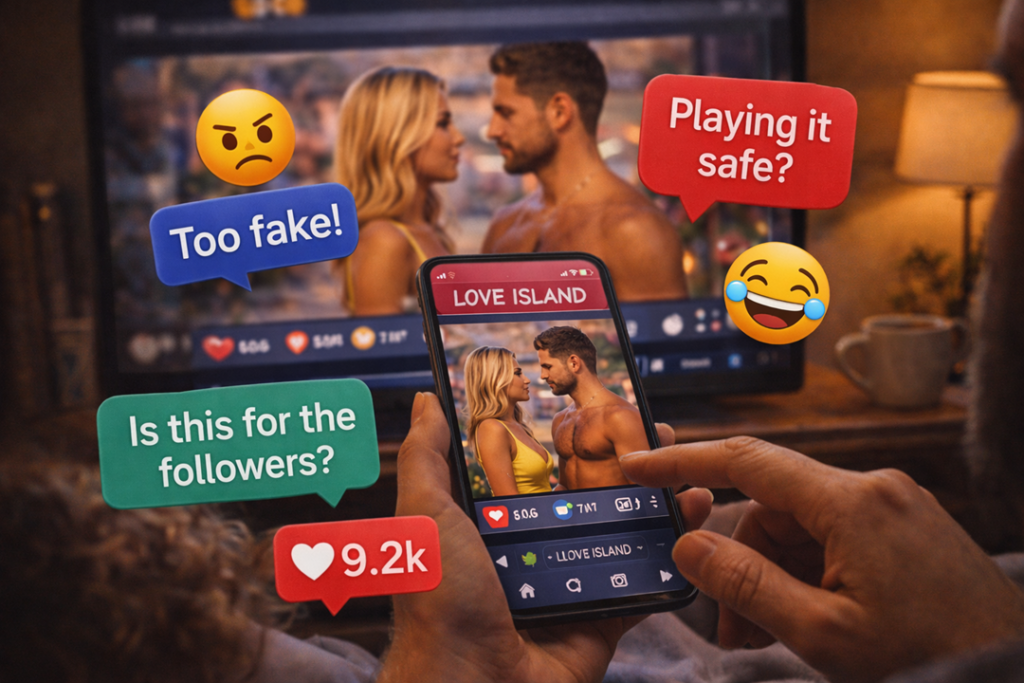
This awareness influences behavior:
- Fewer openly confrontational arguments
- More cautious romantic pivots
- Increased self-editing in confessionals
- Strategic avoidance of controversy
Audience literacy has altered gameplay. Islanders are no longer just pursuing love — they are protecting brand value.
Recent Love Is Blind coverage illustrates a similar trend across romance-based formats, where contestants weigh post-show optics as carefully as in-show compatibility.
The result? Less raw chaos, more calculated presentation.
Ratings Vs. Cultural Impact
While some fans argue the show has “lost its edge,” performance metrics tell a more complicated story.
Streaming engagement remains strong, and international adaptations continue to expand. According to ITV audience performance data, Love Island remains one of the network’s most valuable properties in terms of advertising appeal and digital engagement.
However, cultural dominance is harder to measure.
Earlier seasons produced breakout personalities who transcended the show. In recent cycles, influencer saturation has diluted that effect. When every contestant arrives media-trained, fewer moments feel accidental or viral in an organic way.
The spectacle is intact. The spontaneity may be diminished.
Is The Audience The Real Variable?
It’s worth asking whether the show has changed — or whether viewers have.
Reality audiences in 2026 are savvier. They understand editing manipulation. They dissect narrative arcs in real time. They demand accountability for problematic behavior while simultaneously criticizing contestants for being too careful.
The modern viewer expects:
- Emotional authenticity
- Strategic unpredictability
- Ethical awareness
- Entertainment without overt toxicity
Balancing those expectations is difficult. When Islanders avoid explosive drama, the show feels flat. When they lean into chaos, backlash follows.
The audience has evolved into both critic and co-producer.
Format Fatigue Or Strategic Maturity?
A useful comparison highlights the nuance:
| Early Seasons | Recent Seasons |
|---|---|
| Shock-driven confrontations | Controlled conflict |
| Organic influencer discovery | Pre-built social media presence |
| Reactive public voting | Anticipatory public sentiment |
| Villains framed as disruptive | Villains framed as brand risks |
This table doesn’t suggest decline. It suggests recalibration.
The franchise appears to prioritize sustainability over volatility. Long-term brand safety now outweighs short-term outrage.
That trade-off inevitably changes tone.
The Influence Of All-Stars And Spin-Off Culture
The introduction of All Stars editions further complicates perception. Returning Islanders understand the mechanics and public scrutiny even more deeply than first-timers.
With experience comes strategic restraint.
Instead of impulsive romance, viewers often witness reputational management. The edge softens not because contestants lack personality, but because they understand the cost of miscalculation.
In a broader entertainment landscape where reality crossovers are common, preserving long-term viability matters.
So Has Love Island Lost Its Edge?
The honest answer may be both yes and no.
Yes — the unfiltered unpredictability of early seasons has faded.
No — the show remains structurally strong and commercially viable.
What has shifted is the relationship between contestant, audience, and platform. The feedback loop is immediate. The stakes extend beyond the villa. Every romantic decision doubles as a public brand move.
In that environment, chaos becomes riskier.
Love Island hasn’t disappeared from relevance. It has adapted to a media ecosystem that punishes recklessness and rewards self-awareness.
The edge may look different — less explosive, more controlled — but the franchise continues to evolve alongside its viewers.
And perhaps that’s the point.